
Statement of Educational Effectiveness
BMATS Mission Statement
The purpose of the Seminary’s divisions of undergraduate and graduate studies is to provide accredited undergraduate and graduate theological education for equipping individuals for Christ-centered service and leadership roles; to support the educational needs of the churches and agencies of the Baptist Missionary Association of America and other groups who share a like commitment to the authority of Scripture; and to serve as a resource center for critical thought and research in a context which nurtures the historical, doctrinal character of the churches of the Baptist Missionary Association of America.
Accreditation
Baptist Missionary Association Theological Seminary is accredited by the Southern Association of Colleges and Schools Commission on Colleges (SACSCOC) to award associate, baccalaureate, and masters’ degrees. Questions about the accreditation of Baptist Missionary Association Theological Seminary may be directed in writing to the Southern Association of Colleges and Schools Commission on Colleges at 1866 Southern Lane, Decatur, GA 30033-4097, by calling (404)679-4500, or by using information available on SACSCOC’s website (www.sacscoc.org).
The Commission on Accrediting of the Association of Theological Schools’ (ATS) Educational Standard 2.8 reads: “In the interest of public transparency, the school publishes a statement of educational effectiveness, giving evidence of educational quality by documenting appropriate areas of student achievement for each degree program . . .” SACSCOC also requires the school to publish similar data pertaining to student achievement per the U.S. Department of Education. The data included in this report attempt to make such a statement via direct and indirect measurements.
Graduation Rates
Summary of Actual Rates and Goals
BMA Seminary uses the IPEDS Graduation Rate (150% of normal time) as its SACSCOC Completion metric for measuring graduation rates. The table below presents BMA Seminary’s actual and target percentage goals for graduation from data available as of the 2025 IPEDS data (at-risk populations), DOE College Scorecard (undergraduate rate); Association of Theological Schools 2023-2025 Strategic Information Data and Institutional Peer Profile 2025 (graduate and placement rates).
BMA Seminary Actual Graduation and Placement Rates and Goals
| Actual% | Target Goal % | |
| Undergraduate Graduation Rates | 20 | 45 |
| Identified At-Risk Populations | ||
| Black | 28 | 35 |
| Women | 12 | 35 |
| Graduate Graduation Rates | ||
| MDIV | 50 | 50 |
| MA | NA** | 70 |
|
Placement Rates (2020-2023) |
82 | 90 |
*The placement rate percentage above represents an average between the MDiv and MA for the 2023-2025 academic years.
**While no data appeared for the MA Graduation rates on the 2025 IPPR, previous reports showed an actual rate of 70%
Graduation Rates by Degree and Ecclesial Family for 2025
| BMATS | All ATS Schools | Evangelical Protestant | Mainline Protestant | Roman Catholic/Orthodox | |
| MDIV | 50% | 56% | 47% | 66% | 60% |
| MA | NA* | 50% | 43% | 61% | 51% |
*While no data appeared on the 2025 Strategic Information Report for the MA degrees, previous percentage was 67%.
BMA Seminary’s Enrollment and Completions by Race/Ethnicity and Gender (2016-2025)
| Asian | Black | Hispanic | White | Other | Male | Female | |
| Enrollments | 8% | 23% | 5% | 58% | 2% | 84% | 16% |
| Completions | 8% | 20% | 6% | 57% | 1% | 83% | 17% |
*Data from ATS 2025 Strategic Information Report for BMA Seminary
Regarding Placement Rates
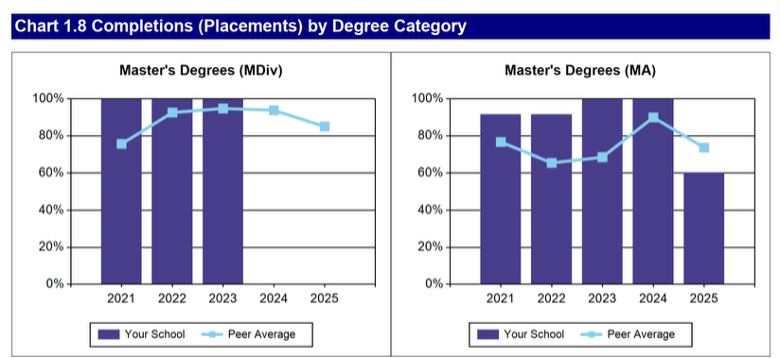
Faculty agreed that Placement Rates demonstrate considerable student achievement. Based upon data appearing in the ATS Institutional Peer Profile Report 2025 (IPPR), a customized annual report based upon peer institutions identified by the BMA Seminary (10 similar institutions), BMA has an excellent Placement Rate for its graduates. Faculty consider 70% a minimally accepted threshold and the maintaining of at least 90% a criteria or target goal. These figures are based upon data collected from the ATS report.
Based upon the 2025 IPPR, from 2021-23, BMA Seminary had a Placement Rate of 100% for the MDiv compared to the average of the peer schools at about 89% (no data showed on the report for BMA Seminary for 2024-25). For all other MA degrees, BMA Seminary had a placement rate of 89% compared to the peer schools at about 74%.
Based upon the above figures and the chart below, BMA Seminary continues to have a higher Placement Rate than its peer schools (see chart below).
Direct measurement of educational effectiveness includes placement upon graduation. The following data reflect the number of graduates from each degree earned from 2016-2026 and identifies ministerial/religious vocations held by students at the time of graduation, their admittance into further educational studies, or other positions not particularly related to a graduate’s field of study:
| Degree | Employed in Ministry | Pursuing Further Education | Other |
|---|---|---|---|
| MDiv | 56% | 27% | 17% |
| MACM | 65% | 18% | 17% |
| MAR | 52% | 16% | 32% |
| MAPT | 67% | 14% | 19% |
| BAR | 48% | 35% | 17% |
| ADIV | 48% | 45% | 7% |
The table shows that 93% of Associate of Divinity, 83% of Bachelor of Arts in Religion, 68% of Master of Arts (Religion), 83% of Master of Arts in Church Ministries, 81% of Master of Arts (Pastoral Theology), and 83% of Master of Divinity graduates from 2016-2026 entered the next level of academic study or held a vocational position related to their fields of study at the time of graduation.
Overall, placement rates for BMA Seminary graduates averaged 82% between all degree programs.
The seminary expects that 80% of graduated students should be employed in ministry or pursuing further education. Also, BMA Seminary’s minimal expectation is to maintain placement rates within 10% of the overall ATS placement rates as revealed by the Strategic Information Report.
Graduate Evaluations
As an indirect measure of learning, graduation questionnaires revealed that graduates were very satisfied with how their program of study enhanced their Christian ministry. Graduates rated their increase knowledge on a scale of 1 to 5.
Master of Divinity graduates (2024-2026) rated their increased knowledge at 4.5 across all degree objectives.
Master of Arts in Church Ministry graduates (2024-2026) rated their increased knowledge at 4.4 across all degree objectives.
Master of Arts (Religion) graduates (2024-2026) rated their increased knowledge at 3.9 across all degree objectives (This particular rating is down from 4.3 during the previous report period).
Master of Arts (Pastoral Theology) graduates (2024-2026) rated their increased knowledge at 4.6 across all degree objectives.
Bachelor of Arts in Religion graduates (2024-2026) rated their increased knowledge at 4.4 across all degree objectives.
Associate of Divinity graduates (2024-2026) rated their increased knowledge at 4.4 across all degree objectives.
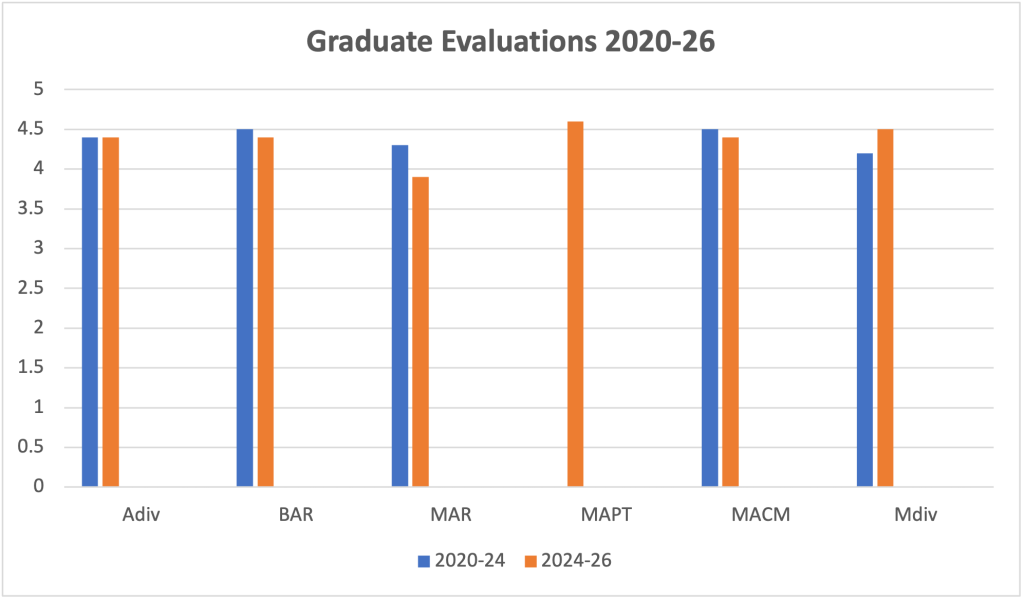 The chart of Graduate Evaluations above demonstrates consistency in student ratings of their increased knowledge over the past eight years.
Regarding Placement Rates
Faculty agreed that Placement Rates demonstrate considerable student achievement. Based upon data appearing in the ATS Institutional Peer Profile Report 2025 (IPPR), a customized annual report based upon peer institutions identified by the BMA Seminary (10 similar institutions), BMA has an excellent Placement Rate for its graduates. Faculty consider 70% a minimally accepted threshold and the maintaining of at least 90% a criteria or target goal. These figures are based upon data collected from the ATS report.
Based upon the 2025 IPPR, from 2021-23, BMA Seminary had a Placement Rate of 100% for the MDiv compared to the average of the peer schools at about 89% (no data showed on the report for BMA Seminary for 2024-25). For all other MA degrees, BMA Seminary had a placement rate of 89% compared to the peer schools at about 74%.
Based upon the above figures and the chart below, BMA Seminary continues to have a higher Placement Rate than its peer schools (see chart below).
Direct measurement of educational effectiveness includes placement upon graduation. The following data reflect the number of graduates from each degree earned from 2016-2026 and identifies ministerial/religious vocations held by students at the time of graduation, their admittance into further educational studies, or other positions not particularly related to a graduate’s field of study:
Employed in Pursuing Further Other
Ministry Education
MDiv 56% 27% 17%
MACM 65% 18% 17%
MAR 52% 16% 32%
MAPT 67% 14% 19%
BAR 48% 35% 17%
ADIV 48% 45% 7%
The table shows that 93% of Associate of Divinity, 83% of Bachelor of Arts in Religion, 68% of Master of Arts (Religion), 83% of Master of Arts in Church Ministries, 81% of Master of Arts (Pastoral Theology), and 83% of Master of Divinity graduates from 2016-2026 entered the next level of academic study or held a vocational position related to their fields of study at the time of graduation.
Overall, placement rates for BMA Seminary graduates averaged 82% between all degree programs.
The seminary expects that 80% of graduated students should be employed in ministry or pursuing further education. Also, BMA Seminary’s minimal expectation is to maintain placement rates within 10% of the overall ATS placement rates as revealed by the Strategic Information Report.
Graduate Evaluations
As an indirect measure of learning, graduation questionnaires revealed that graduates were very satisfied with how their program of study enhanced their Christian ministry. Graduates rated their increase knowledge on a scale of 1 to 5.
Master of Divinity graduates (2024-2026) rated their increased knowledge at 4.5 across all degree objectives.
Master of Arts in Church Ministry graduates (2024-2026) rated their increased knowledge at 4.4 across all degree objectives.
Master of Arts (Religion) graduates (2024-2026) rated their increased knowledge at 3.9 across all degree objectives (This particular rating is down from 4.3 during the previous report period).
Master of Arts (Pastoral Theology) graduates (2024-2026) rated their increased knowledge at 4.6 across all degree objectives.
Bachelor of Arts in Religion graduates (2024-2026) rated their increased knowledge at 4.4 across all degree objectives.
Associate of Divinity graduates (2024-2026) rated their increased knowledge at 4.4 across all degree objectives.
Rational for Educational Effectiveness
For more detail regarding BMA Seminary’s Rationale for Educational Effectiveness is available with the attached link.